Thursday, September 22, 2011

No Encouragement on the Horizon --- Stocks Get Hammered

On September 2nd I posted some thoughts about areas of concern for the US and global economies (see "Some Random Thoughts About Who We Can Trust and Other Stuff").  It's time to update some of those observations given what has transpired over the past three weeks, namely:  President Obama's address to the joint session of Congress on September 8th re: jobs creation ("the American Jobs Act"); the President's announcement several days later as to how to pay for the jobs legislation he proposed; the President's deficit-reduction proposal that he put on the table a couple of days ago; the Republicans' reactions to those proposals; the Federal Reserve's actions of yesterday ("Operation Twist"); the continuing drama with respect to the Eurozone debt crisis; and various economic numbers re: the US and global economies.

The American Jobs Act, Deficit Reduction and Republicans' Reactions - The cost of the proposed jobs legislation would be about $447 billion.  Perhaps 1/2 of this (maybe more) would not create new jobs --- rather, it would effectively provide cash flows to various groups that would maintain current spending levels and, thereby, not cause economic deterioration and further job losses.  (This is certainly important to assure that the economic softness that we are already experiencing is not exacerbated.)  The other half would be split between creating new jobs (e.g., infrastructure spending) and providing businesses with greater cash flow (e.g., lower payroll taxes).  The problem with this latter issue is whether businesses will spend the increased cash flow in creating new jobs or let it accumulate along with the trillions of cash that already resides on corporate balance sheets.  Overall, I'm not convinced that the American Jobs Act is a bold and imaginative enough program to stimulate the US economy to growth.  Moreover, I don't believe businesses will create new jobs before there is increased demand for their products --- and I don't think the American Jobs Act (even if enacted in its entirely) will stimulate very much increased product demand.

With respect to the President's deficit reduction proposal, the concepts are fine: entitlement reform, tax reform, reduced spending --- but the devil will be in the details and the whole proposal has been effectively kicked over to the Congressional Deficit-Reduction Super Committee.  I still lack confidence that the Super Commitee can reach bi-partisan compromise on the details of any deficit-reduction program.

And then we have the Republicans' (and some Democrats') reactions to the Jobs Act and Deficit-Reduction proposals.  The Rs don't want any tax revenue increases and the Ds don't want any significant entitlement reform.  This is an equation for continuing partisan gridlock, with no end in sight.

   

Finally, my overall reaction to the Obama job and deficit-reduction proposals and the Rs' responses is this --- it's all about campaign politics and not about advancing meaningful policy proposals designed to effect bi-partisan solutions in the next few months to enhance the lackluster US economic recovery.

Eurozone and China - The problems in the Eurozone continue and no resolution is on the horizon.  Further, recent economic data for the Eurozone economy have provided evidence of further slow-down or contraction.  Moreover, it appears China's economy is also slowing more than anticipated.  Bottom line --- the global recovery is in trouble.

The Federal Reserve – Yesterday's actions to implement Operation Twist suggest the Fed is limited in helping the economy by the tools remaining in its monetary toolbox.  Further, the Fed commented "there are significant downside risks to the economic outlook, including strains in global financial markets."  Not very encouraging.

Republicans in Congress - In my post of September 2nd I raised the question of whether we can trust the House and Senate to agree to anything that looks like it will give Obama new life for the 2012 election process.  How can we trust the Republican caucus to agree to meaningful fiscal stimulus to salvage the US recovery and lower unemployment levels before the election?  Based on recent rhetoric, the answer is "we can't" --- and the subtext is "and let the American people be damned" for another 13 months until the 2012 election.

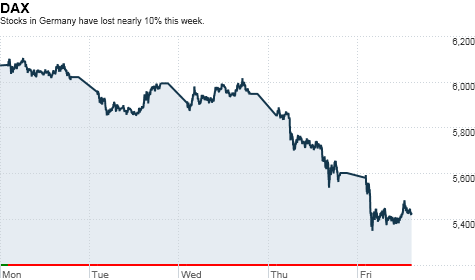
And, in large measure, because of all these issues - Today US and global stocks get hammered. 


Friday, September 2, 2011

Some Random Thoughts About Who We Can Trust and Other Stuff

A week ago I got out of the market as I closed all my volatility/momentum trades when the S&P 500 was @ 1175 --- it’s now @ 1205 (but this morning’s futures are looking as though the index will head considerably lower today because of the terrible August payrolls/earnings/unemployment report).  I don’t mind losing those 30 points (probably less than that when the post-payrolls-report market opens this morning) because I didn’t have to worry about any potential damages from either the Bernanke Jackson Hole speech last Friday (even though it didn’t result in a downdraft for the market) or Hurricane Irene (even though the damage was less than most weather experts anticipated).  Sleeping better at night was worth the trade-off between a somewhat higher market and a potentially significantly lower trading level.

This leads me to consider where we now find ourselves and who can (and, more importantly, who will have the courage to) lead the US and global economies toward recovery and away from a double-dip recession.  To that end, the following are some random thoughts on various issues.

Eurozone and European Central Bank – New sovereign debt problems (or the same old problems) in Italy and Greece are again negatively impacting the Eurozone and the European markets.  Can we trust the Eurozone countries and the ECB to work together to bolster the sagging Eurozone economy?  In the short-run, austerity by the offending countries without some stimulative actions by the ECB doesn’t seem to be the immediate answer.

US Exports to the Eurozone – According to a Brookings Institution research report1, we export over $300 billion a year to Eurozone countries and virtually all of the rest of our exports go to nations that also export to the Eurozone.  If the European economy continues its sag, this would have a measurable effect on the US recovery.  We can’t afford inaction or ineffective action by the ECB and the Eurozone countries.
1 source: http://www.brookings.edu/papers/2011/0822_euro_crisis_elliott.aspx#note1, Why Can’t Europe Get it Right the First Time… or the Second… or the Third?

The Federal Reserve – Chairman Bernanke’s speech in Jackson Hole last Friday didn’t lay out any new actions it might take with respect to stimulating economic growth.  Was that just a kick of the can down the road to motivate the Congress and the WH to engage in meaningful fiscal policy before the Fed committed to any additional actions --- or is the Fed limited by the remaining tools in its monetary toolbox --- or both?  In spite of the no-news Jackson Hole speech, the market moved higher.  I think prematurely.

President Obama – Can we trust Obama to have the imagination and courage to put a big jobs package on the table in his Joint Session of Congress Address next week and really fight for it?  And, more importantly, even if the answers are affirmative, does he have the political skill and capital to effect a bipartisan result?

Congress - Can we trust the House and Senate to agree to anything that looks like it will give Obama new life for the 2012 election process?  Speaker of the House Boehner won’t even agree to the date and time of a speech by Obama --- how can we trust him to get his Republican caucus to agree to meaningful fiscal stimulus to salvage the US recovery and lower unemployment levels before the election?

Congress’ Super Committee - Lots of questions and little optimism on my part at the moment.

Infrastructure Investment – This is something that needs to be put in place now to effect long-term economic growth.  Will the WH and Congress have the courage to do something big now when borrowing costs are so low?

Big U.S. Banks - These banks and smaller banks need to make loans available to small/mid-sized businesses (the real job creators).  Can we trust the banks to do this or will the big banks, subsidized by the Fed over the past three years with near-zero interest rates, just keep on arbitraging the effectively-free funds with low-risk investments (i.e., US Treasury securities and the like)?

Consumers – We had one decent consumer spending number this past Monday.  This gave some encouragement to the markets that the consumer isn’t totally sitting on the sidelines --- but we need consumers to keep spending.

Gold and Swiss Franc Investors – As global uncertainly has been the watchword of late, investors have sought the “safe-haven” of gold and strong currencies.  However, if we are to see the equity markets move to the upside, a prerequisite will be that these investors see less risk in the global economy and redeploy funds into other than these “safe-haven” investments.

Corporations – Can we trust them to hire without legislated fiscal incentives or without an increase in demand for their products?  In a word, no.  And, as a free-market capitalist, I wouldn't expect or advocate corporations to do anything that isn't in their own long-term self interest (to be read as including all their constituencies --- shareholders, employees, customers, communities, etc.).

Having said all that, there may be some hope that September will be better for the equity markets than was August.  (In August the S&P 500 opened the month @ 1292 and closed it @ 1219, a decline of 5.6%.)  Some of what normally happens in September happened in August, such as economic forecast revisions.  Also, some of the shocks from the Eurozone and the US debt ceiling debate/S&P credit downgrade were put behind us in some fashion or other.  However, can we trust that there won’t be new or renewed shocks in September to create more volatility in the equity markets?

As a final comment, I noted within the past couple of days (after we regained communication with the world following Hurricane Irene’s pass through our area) that earlier this week CNBC conducted an interview with Abbey Joseph Cohen of Goldman Sachs (an equity market guru who merits considerable respect).  It was reported on CNBC’s website that Cohen “reiterated her forecast for the Standard & Poor’s 500 reaching 1450.”  At first read, this really surprised me and with good reason.  This is terrible reporting --- and I have commented to that effect on the CNBC website.

Cohen’s 1450 forecast was made in June 2011 --- this when the S&P 500 was trading near the 1300 level.  Specifically, the Cohen/GS prediction, based upon all the information available in June, was that the S&P 500 would close out 2011 in the 1450 range.  However, if you view the tape of the recent interview2, what Cohen actually says is this, “the US portfolio strategy team believes that over the next 12 months we can see the S&P 500 reach about 1450.”  1450 by year-end 2011 vs. 1450 by the end of August 2012 are two entirely different animals.  This is clearly not a "reiteration" of Cohen's forecast.  Shame on CNBC.

To end on a positive note, the Yankees beat the Red Sox last night and are tied in the loss column for first place in the AL East.  The Yankees have one more three-game series with the Red Sox this year --- on September 23rd, 24th and 25th at Yankee Stadium.  If both teams take care of business between now and then, it will make for an exciting close to the regular season.


Friday, August 26, 2011

The Need for Additional Fiscal Stimulus

As Fed Chairman Ben Bernanke made clear today in his Jackson Hole speech, policy makers beyond the Fed need to actively participate in stimulating aggregate demand in the economy (i.e., Congress and the White House need to do their fair share with respect to fiscal policy stimulus.)  Nobel Prize-winning economist Peter Diamond comments on the need for additional fiscal stimulus, especially in the form of infrastructure investment, to help grow the US economy and reduce unemployment. 

Ben Bernanake and Hurricane Irene

Between Fed Chairman Bernanke's upcoming comments this morning and the approach of Hurricane Irene this weekend, I think I'll just stay hundered down for the next few days.  I liquidated all equity positions yesterday and find little reason to take any new investment risk until the BB speech and Irene damage can be assessed.


Thursday, August 25, 2011

Approaching Bernanke’s Jackson Hole Speech – 2011 Version

For the past couple of weeks I’ve been engaged in short-term momentum/volatility equity trading (including leveraged ETFs) on a limited basis.  This has worked very well as I’ve bought when I thought the market has over-reacted on the downside and sold when the market has recouped the over-reaction on the upside.

However, as we approach Fed Chairman Ben Bernanke’s speech tomorrow in Jackson Hole, I’m preparing to liquidate at the open of the market today my current equity positions.  I’m concerned that the equity markets are expecting BB to say something to further buoy stock prices --- and I’m not sure what he can say to meet those expectations.

It seems to me there is more downside risk than upside potential attaching to the BB speech.  There are many who believe the Fed has exhausted the tools in its toolbox and won’t be able to do much more to promote more employment in the economy.  It appears fiscal policy will be the best way to create jobs --- and we all know how dysfunctional Congress is at the moment for this to be a realistic short-term result.  (For an example of this monetary- vs. fiscal-policy discussion, see http://economix.blogs.nytimes.com/2011/08/24/how-much-more-can-the-fed-help-the-economy/.)

If this is a correct assessment, the markets could again fall to their lows of the past month --- and if not correct, what’s the loss of a few upside points by comparison?

Getting ready to fasten my seatbelt for the bumpy ride ahead.

Tuesday, August 23, 2011

Why Is The Eurozone So Important?

Here's a lead-in paragraph to a Brookings Institution article by Douglas Elliott that is a good summation as to why we need to be concerned about the Eurozone economy and its effect on the US economy.

"The Euro Crisis has struck again, hammering not just European markets, but doing real damage to U.S. markets and to economic prospects around the world. The U.S. could easily be pushed into another recession if the eurozone collapsed. We export well over $300 billion a year to those 17 countries; virtually all of the rest of our exports go to nations that also export to the eurozone and would feel ripple effects; roughly two-fifths of our overseas assets are invested in the eurozone; and our major financial institutions have large credit exposures to eurozone banks and other businesses."

source:  http://www.brookings.edu/papers/2011/0822_euro_crisis_elliott.aspx#note1, Why Can’t Europe Get it Right the First Time… or the Second… or the Third?

Hope You Weren't Looking For A Cheerful Beginning To The Day

Let’s Be Honest: We’re in a Depression, Not a Recession, And There’s No End In Sight

Richard A. Posner


Saturday, August 20, 2011

Euro Debt Crisis: No Solution in Sight


@CNNMoney August 19, 2011: 10:24 AM ET
european stocks
NEW YORK (CNNMoney) -- European leaders are under intense pressure to come up with a long-term solution to the debt problems straining the European Union to its breaking point.  But given the enormous challenges involved and the unpalatable options available to them, few analysts expect EU policymakers to announce any meaningful changes soon.

"There is no solution to the Euroland's sovereign debt crisis in sight," said Carl Weinberg, an economist at High Frequency Economics. "Markets will continue to be fundamentally unstable and volatile as long as we can think."

French President Nicolas Sarkozy and German Chancellor Angela Merkel gave it their best shot on Tuesday.  The leaders of Europe's largest economies announced proposals they said will encourage fiscal discipline and increase economic competitiveness across the euro zone.

Investors were not impressed.  Stock markets across Europe fell Friday, extending Thursday's big sell-off. Shares in Frankfurt fell 3%, while the main market indexes in London and Paris were down about 1.5%.

"The market gave Merkel and Sarkozy their chance to stop the Euro crisis," said Clem Chambers, chief executive of European financial market website ADVFN. "Today it is responding to their inaction."

Shares of European banks have been hit particularly hard. Concerns about the banking sector flared Thursday following reports that an unnamed institution borrowed $500 million from one of the European Central Bank's emergency lending facilities.

Will Europe come tumbling down?

Investors were hoping for more concrete measures to stabilize shaky government finances. They want to see a big increase in the size of the EU stability fund and many are calling for the creation of a so-called euro bond.

Sarkozy and Merkel dashed those hopes, saying the 440 billion euro stability fund is sufficient and a bond backed by the euro zone as a group would not solve all the region's debt problems.

The proposals the leaders did put forth -- requiring all 17 euro zone nations to commit to balanced budgets, giving the EU bureaucracy more fiscal authority and imposing some sort of transaction tax -- were widely seen as inadequate.

Analysts said serious questions remain about how effective the proposals would be and whether member nations will agree to them.  Jennifer McKeown, an economist at Capital Economics in London, said "decisive steps" towards a more uniform fiscal policy are necessary "if the currency union is going to hold together in its current form."

EU leaders have pledged to do what is necessary to protect the euro. And the latest rhetoric has been about fiscal "integration" and economic "convergence."

So far, the EU has responded to the debt problems in Greece, Portugal and Ireland by throwing billions of bailout euros at them in the hope that harsh austerity measures would do the rest.

As the crisis intensified over the last few weeks, the European Central Bank started buying Spanish and Italian bonds in a bid to prevent a broader debt contagion.  But the aggressive moves that investors are looking for would require fundamental changes in the business model, such as it is, of the European Union.

Europe's debt crisis: Expect more trouble

In essence, the larger EU economies will be required to shoulder more of the burden stemming from the fiscal indiscretions of their smaller neighbors.  That presents a difficult political problem for Germany and France, where voters must approve such measures.

"In the end," said McKeown, "the euro zone's strongest economies might decide that the potential costs of allowing the euro zone to fail, perhaps in the form of a banking crisis, are even greater than those of supporting it." To top of page

Friday, August 19, 2011

Sitting on the Sidelines

For the most part, I've been sitting on the sidelines for the past month with cash reserves in all the investment accounts I manage.  The debt ceiling debacle together with the do-nothing-but-stymie-our-economy debt ceiling legislation together with weak US and Eurozone economic numbers together with the Eurozone debt problems together with weak (or non-existent) economic leadership on both sides of the Atlantic have only added to my resolve to wait until there is some light at the end of the global economy tunnel before committing to non-cash investment alternatives.

On the other hand, with 30-year US Treasury yields sitting at 50-year lows, is there an opportunity (albeit longer term) to short the US Treasury market and ride the yield curve up as yields inevitably rise over the next few years?  I'm considering this possibility, but there's no rush since the Fed has effectively said they will maintain a low-interest-rate policy for the next two years.

But, for the moment, still sitting on the sidelines ---

Thursday, August 18, 2011

Will This Roller Coaster Go Up Anytime Soon?

Last week I thought the market bottom was about 1120 on the S&P 500 (the intraday market low last week was actually 1101) --- now, I'm not so sure.  The latest economic numbers for the US and Eurozone economies show more weakness than the forecasters expected.  In addition, neither the US nor the Eurozone is getting any of the bold leadership that will be required to achieve global economic growth and avoid global recession.

Buckle up and let's hope some in Washington and Europe find the courage to be bold.

This Path Leads Us To Global Recession

What is most bothersome about the blah-blah-blah we are now hearing from the Republican Presidential candidates and from President Obama is that none of the blah-blah-blah contains any solutions to the economic malaise we are experiencing in the US.  And the same is true of European leaders with respect to the Eurozone's economic problems.

The US economy remains the largest in the world, while the aggregate of the Eurozone country economies is second largest.  If these economies falter any further, we are almost certain to be on a path toward global recession.

We need bold leadership on both sides of the Atlantic to move the global economy toward growth and away from recession --- and we aren't getting any kind of leadership at the moment.

Tuesday, August 16, 2011

What We Need --- Aggregate Demand

There is lots of talk in Washington (or Iowa or New Hampshire or wherever the presidential wanna-bees are campaigning) about "jobs programs."  Unfortunately, many of these ideas are on-the-margin concepts which will not do very much to stimulate massive aggregate demand.  And aggregate demand is the best way to turn our economy around and to create jobs and lower the unemployment rate.

Further, private enterprise will not add jobs until there is either demand for their goods and services to warrant creating more jobs, or incentives are legislated that encourage self-interest decisions on their part to create more jobs.

My own view is "infrastructure, infrastructure, infrastructure."  (See my prior post on infrastructure investment --- http://theviewfromthemiddleoftheroad.blogspot.com/2011/08/congress-and-president-are-bankrupt-of.html)

Bruce Barlett opined on "aggregate demand" today.  Here is his view --

August 16, 2011, 6:00 am 

It’s the Aggregate Demand, Stupid
By BRUCE BARTLETT  (Bruce Bartlett held senior policy roles in the Reagan and George H.W. Bush administrations and served on the staffs of Representatives Jack Kemp and Ron Paul.) 

With the debt limit debate temporarily set aside, the Obama administration is talking about finding some way to create jobs and stimulate growth. But the truth is that there really isn’t much it can do and it knows it. There may be some small-bore things it can do without Congressional action that may help a little, but the operative word is “little.” The only policy that will really help is an increase in aggregate demand.
Aggregate demand simply means spending — spending by households, businesses and governments for consumption goods and services or investments in structures, machinery and equipment. At the moment, businesses don’t need to invest because their biggest problem is a lack of consumer demand, as a July 21 study by the Federal Reserve Bank of New York documented.
The federal government could increase aggregate spending by directly employing workers or undertaking public works projects. But there is no possibility of that given the political gridlock in Congress and President’s Obama’s desire to appear moderate and fiscally responsible going into next year’s election.
That really leaves just consumers as a potential avenue for increasing spending. But that will be difficult as long as unemployment remains high, thus reducing aggregate income, and households are still saving heavily to rebuild wealth, which was decimated by the collapse in housing prices. Saving is, in a sense, negative spending.

Changes in wealth affect spending because people will spend a percentage of their increased wealth. And they are more likely to raise their spending when the wealth increase is perceived to be permanent rather than transitory.
Historically, people have viewed increases in home equity as more permanent than increases in stock market wealth because they know the latter is more volatile. A recent Federal Reserve Board working paper estimated that the long-run increase in spending from an increase in housing wealth may be as high as 9.1 percent per year.
As home prices increased, many people came to believe they had no real reason to save since they could always tap their home equity — which banks were more than happy to help them do — in the event that they needed funds. Thus the personal saving rate fell from 3.5 percent in the early 2000s to just 1.4 percent in 2005 at the peak of the housing bubble.
Home prices roughly doubled between 2000 and 2006, according to the Case-Shiller index, and many homeowners talked themselves into believing they would continue rising indefinitely. Thus they increased their spending and reduced their saving based not only on actual price increases, but also on expectations of future increases.
A prescient 2007 Congressional Budget Office study explained how this would affect spending and growth in the economy. It said that if people were expecting a 10 percent rise in home prices and instead they fell 10 percent, the impact on spending would be equivalent to a 20 percent fall in prices. The budget office estimated that this might reduce growth of gross domestic product by 2.2 percent per year. Since actual home prices have fallen by about a third, this suggests that G.D.P. may be $500 billion less this year than it would be if home prices had simply remained flat since 2006.
One way that the rise and fall of spending can be visualized is by looking at the velocity of money. This is the speed at which money turns over in the economy. When velocity rises, more G.D.P. is produced per dollar of the money supply. When velocity falls, the economic impact is exactly the same as if the money supply shrank by the same percentage.
The chart below comes from the Federal Reserve Bank of St. Louis and shows velocity as the ratio of the money supply (M2) to nominal G.D.P. It rose from 1.85 in 2003 to 1.96 in 2006. It has since fallen to a current level of 1.66. Thus one can say that each $1 increase in the money supply produced almost $2 of G.D.P. in 2006 and only $1.66 today.
Velocity of M2 money supply, expressed as the ratio of quarterly nominal G.D.P. to the quarterly average of M2 money stock. (Shaded areas indicate United States recessions.)
This suggests that the Federal Reserve could have offset the decline in spending and velocity resulting from the fall in home prices with a sufficient increase in the money supply. And it tried. Since 2006, money supply has increased by about $2 trillion. But velocity fell faster than the money supply increased as households reduced spending and increased saving — the saving rate is now over 5 percent — and banks and businesses hoarded cash.
Nonfinancial businesses are now sitting on close to $2 trillion in liquid assets that could be invested immediately if there was an increase in sales, and banks have $1.5 trillion of excess reserves that could be lent as well.
Fiscal policy could raise velocity and growth by getting money moving throughout the economy. But since that is not feasible, the Fed is the only game in town. Joseph Gagnon, a former Fed economist, says that it should immediately increase the money supply by $2 trillion and promise to keep increasing it until the economy has turned around.
But the Fed is already under pressure to tighten monetary policy from its regional bank presidents, three of whom dissented from last week’s Fed decision to keep policy steady. They fear that inflation is right around the corner. But as the Harvard economist Kenneth Rogoff has argued, a short burst of inflation would do more to fix the economy’s problems than any other thing. One reason is that inflation raises spending by encouraging consumers and businesses to buy things they need immediately because prices will be higher in the future.
The right policy can be debated, but the important thing is for policy makers to stop obsessing about debt and focus instead on raising aggregate demand. As Bill Gross of the investment firm Pimco put it recently: “While our debt crisis is real and promises to grow to Frankenstein proportions in future years, debt is not the disease — it is a symptom. Lack of aggregate demand or, to put it simply, insufficient consumption and investment is the disease.”